


Search specifically
Identifiers and other available information help find the correct cage.
Cage management connects cage ID, location, cage type and occupancy. In this way, your team can find the spatial connection to the animals being kept.
Identifier, cage type and area form the starting point.
Function example with synthetic data
Identifiers and other available information help find the correct cage.
The assigned animals remain connected to their home cage and thus the location.
Cage and breeding cards use existing information; digital editions depend on the activated connection.
Location, cage type and assigned animals are visible together.
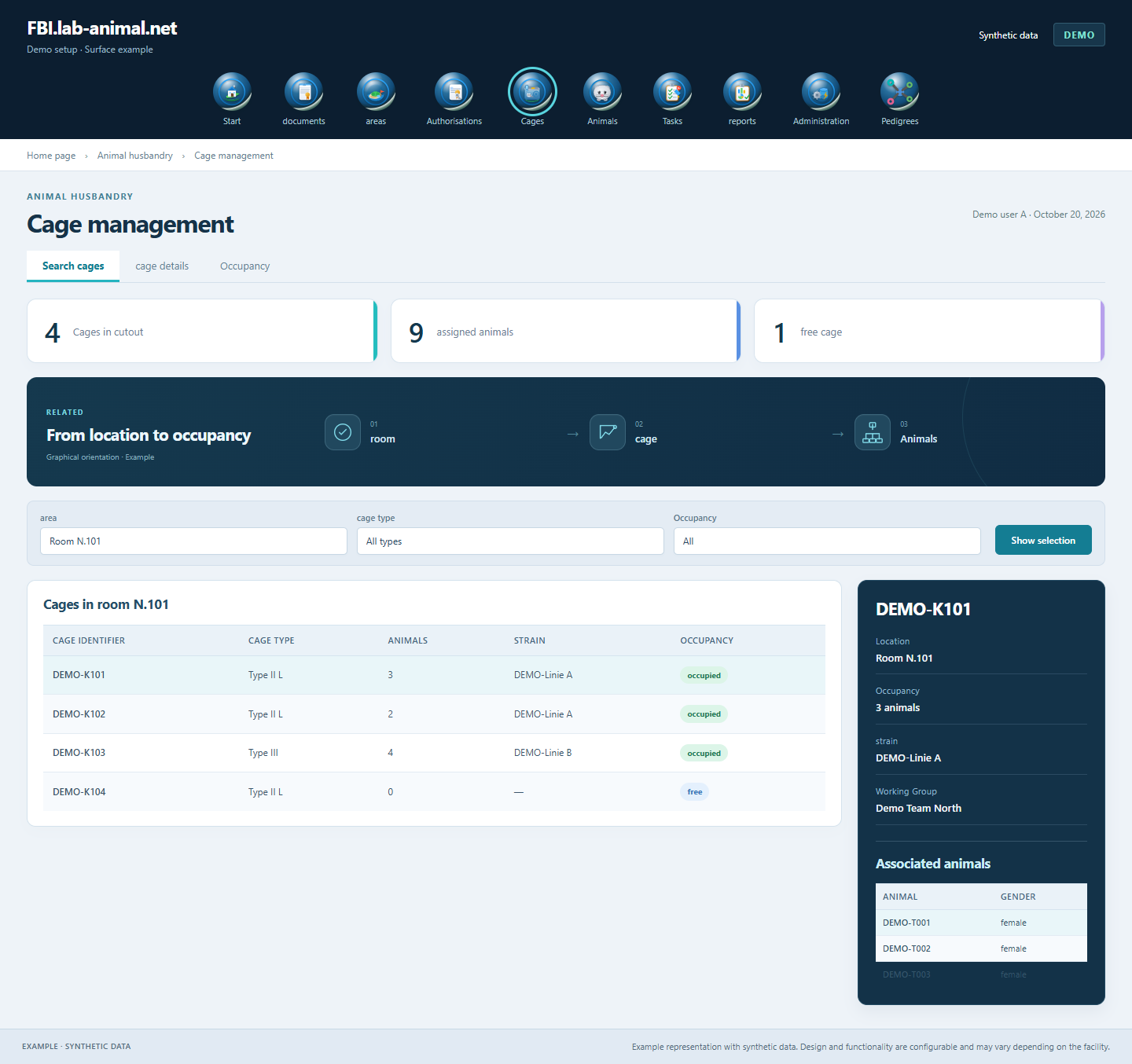
A common data set holds spatial assignment and animal reference together. The actual occupancy is maintained via the associated specialist processes.
Select or capture identifier and cage type.
Arrange the cage into the existing area structure.
Maintain the home cage in the respective animal context.
Use the appropriate card or activated digital edition.
Identifier, cage type, location and animal occupancy are shared. Cards and digital editions continue to use the information stored.
In addition to the single system, a multiple system is available. This allows recurring recordings for several cages to be combined.
The occupancy shows the assigned animals. The location can also be traced via their home cage.
Cage types are maintained as common master data and assigned during creation. This supports uniform recording.
Example representation with synthetic data. Design and functionality are configurable and may vary depending on the facility.
Together we will clarify what scope suits your facility and what the introduction can look like.
Let’s talk