


Assign events
Date, heading, content and the person documenting create a comprehensible reference.
The animal diary brings together animal-related entries and documented histories. Observations, weights and ratings remain assigned to an animal and a point in time.
| Date | entry |
|---|---|
| 01.10.2026 | Observation documented |
| 02.10.2026 | Weight recorded |
| 03.10.2026 | Further observation |
Time and animal reference make observations traceable over time.
Function example with synthetic data
Date, heading, content and the person documenting create a comprehensible reference.
Existing weight entries can be displayed as a history.
Reviews and other animal-related histories remain accessible via the animal.
Diary entries and weight history are in the common animal context.
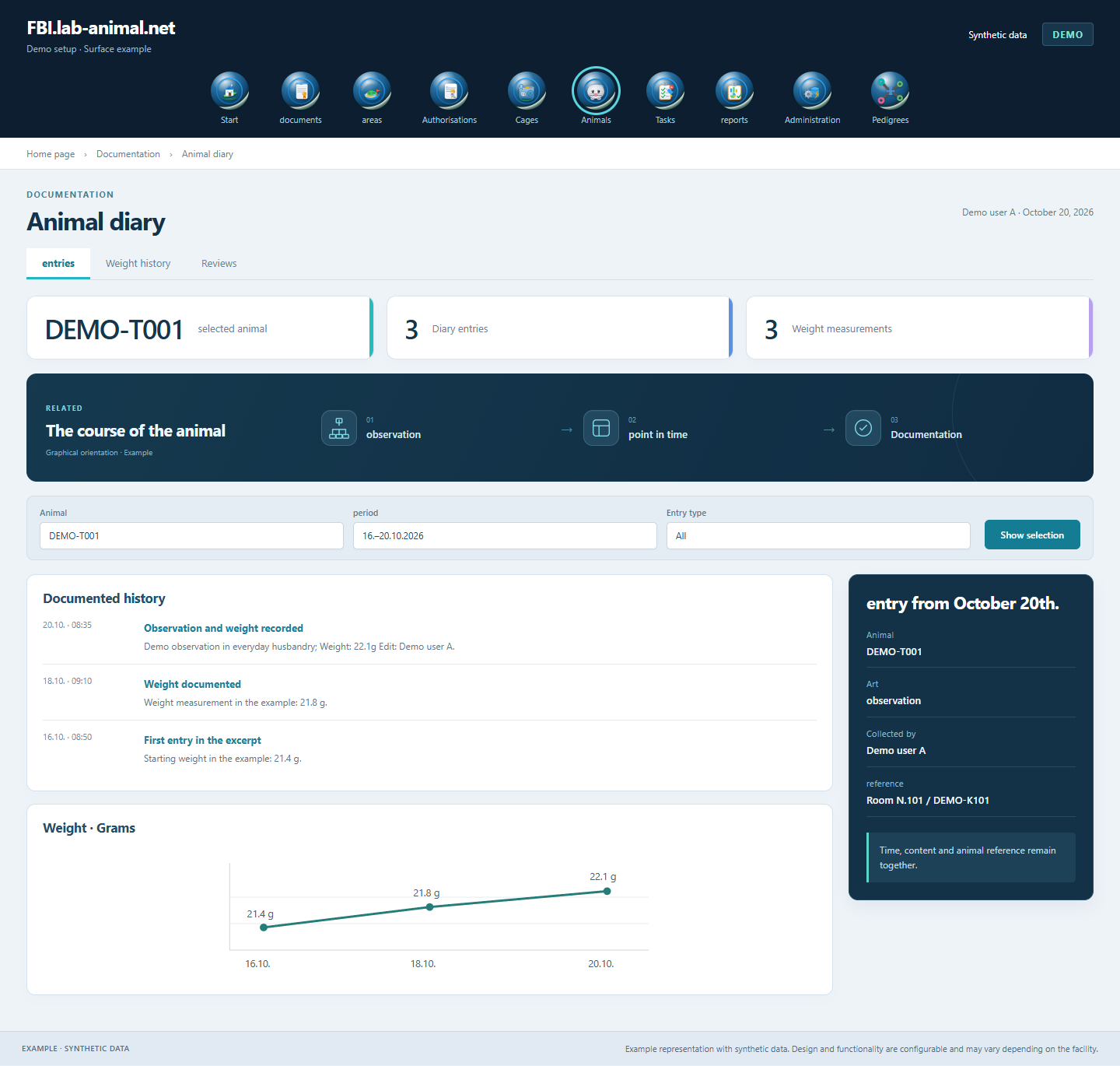
Individual observations create a comprehensible progression. Your team can find previous entries and compare documented changes over time.
Check the correct record based on its identifier.
Record observation and actual time in the associated entry.
View previous entries and existing measurement or evaluation values together.
Initiate and document necessary measures by the responsible persons.
Observations, weights and ratings remain linked to animal and time. This means the documented history can be read clearly.
Date, heading, content and documenting person clearly assign observations and events. Previous entries remain accessible in the animal context.
Saved weight entries can be viewed as a history. This makes it easier to compare the documented points in time.
Reviews and other animal-related information are accessible on the same animal. Observations and evaluation results can thus be classified together.
Example representation with synthetic data. Design and functionality are configurable and may vary depending on the facility.
Together we will clarify what scope suits your facility and what the introduction can look like.
Let’s talk