


Standardize terms
Commonly maintained root names support understandable assignment.
strains and lines receive their own descriptive context. This means that origin, genetic background and other technical information do not have to be collected anew for each animal.
A common master data set can support many animal references.
Function example with synthetic data
Commonly maintained root names support understandable assignment.
Genetic background, marker information and descriptive characteristics remain available on strain.
Breeder and source information and associated information support tracking.
Strain name, background, origin and technical information are bundled.
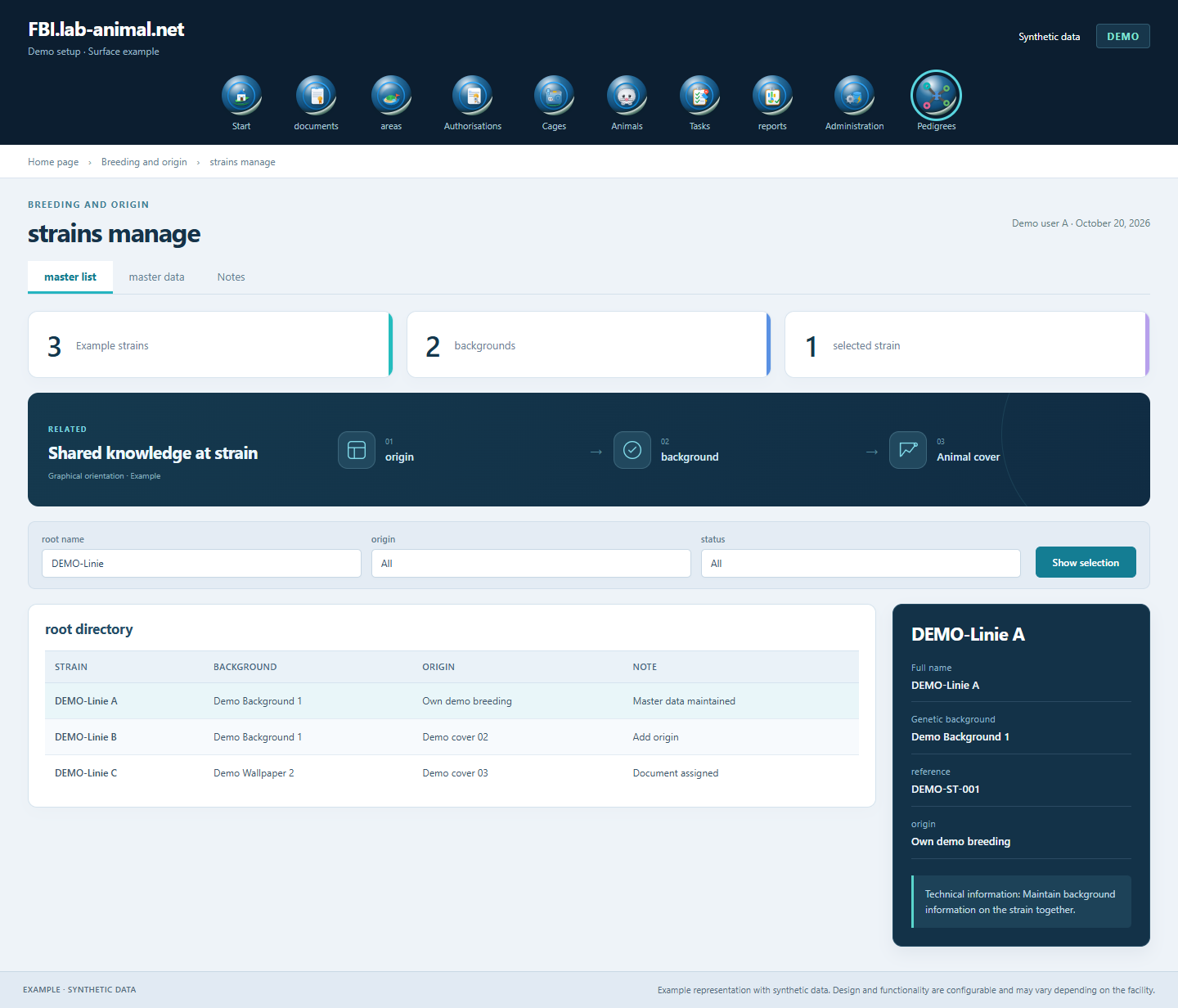
Commonly maintained master information bundles specialist knowledge for many animals. Individual findings supplement this reference directly on the respective animal.
Before creating a new one, search for a suitable existing reference.
Document name, background and relevant characteristics.
Assign breeders, reference identifiers and other specialist information.
Use the appropriate reference and note individual deviations.
Maintain origin, genetic background and descriptive characteristics once on strain and use this common reference for the associated animals.
Strain name, origin, genetic background, marker information and descriptive characteristics bundle the common knowledge.
A common root reference makes it easier to assign many animals and standardizes recurring information. Individual animal findings remain documented on the respective animal.
Descriptive fields record health, stress and other technical information. The responsible persons maintain content and usage.
Example representation with synthetic data. Design and functionality are configurable and may vary depending on the facility.
Together we will clarify what scope suits your facility and what the introduction can look like.
Let’s talk